
Since NMFTA Docket 2025-1 took effect on 19 July 2025, most LTL freight is classed by density: pounds per cubic foot. A 13-step scale runs from class 400 (under 1 lb/ft³) to class 50 (50 lb/ft³ or more), so accurate dimensions and weight for each handling unit decide the class.
Key facts
| Who sets the classes | The National Motor Freight Traffic Association (NMFTA), which publishes the National Motor Freight Classification (NMFC) |
|---|---|
| What changed | Docket 2025-1 moved most NMFC items to density-based classes and consolidated many commodity-specific items |
| Effective date | 19 July 2025 |
| Density | Weight in pounds ÷ volume in cubic feet |
| Cubic feet | Length × width × height in inches ÷ 1,728 |
| Scale | 13 density sub-classes, from class 400 (under 1 lb/ft³) to class 50 (50 lb/ft³ or more) |
| Exceptions | Some items keep a class of their own: check your item in the NMFC |
| Later changes | NMFTA publishes new dockets several times a year. Check the current NMFC before relying on any table |
What changed in 2025?
Before July 2025, an item's NMFC class reflected four transportation characteristics: density, handling, stowability and liability. Many commodities had a class of their own, set in their NMFC item.
Docket 2025-1 made density the main factor. Most items now point to one density scale with 13 sub-classes, and many commodity-specific items were consolidated into it. For a shipper, that means the class of most LTL freight now follows from the measured dimensions and weight of each handling unit, not from what the product is.
Two things follow. First, a class assigned to a product years ago is no longer a safe default: the same product on a different pallet build can land in a different class. Second, carriers check. When a carrier's own measurement gives a different density, it can reclass the shipment and bill the difference. Your tariff and pricing agreement with the carrier still decide what you pay; the class is one input to it.
The density scale To confirm against NMFTA before publishing
The 13 density sub-classes as we understand them from Docket 2025-1. A reviewer must check every row against the docket before this page goes live.
| Density (lb per cubic foot) | Class |
|---|---|
| Less than 1 | 400 |
| 1 to less than 2 | 300 |
| 2 to less than 4 | 250 |
| 4 to less than 6 | 175 |
| 6 to less than 8 | 125 |
| 8 to less than 10 | 100 |
| 10 to less than 12 | 92.5 |
| 12 to less than 15 | 85 |
| 15 to less than 22.5 | 70 |
| 22.5 to less than 30 | 65 |
| 30 to less than 35 | 60 |
| 35 to less than 50 | 55 |
| 50 or more | 50 |
Lower density means a higher class number, and usually a higher rate per pound.
Worked example: a 48 × 40 × 52 in pallet at 650 lb
One handling unit: a standard 48 × 40 in pallet, loaded to 52 in high including the pallet, weighing 650 lb on the scale.
| Step | Calculation | Result |
|---|---|---|
| 1. Measure | Length, width and height at the extreme points | 48 × 40 × 52 in |
| 2. Volume in cubic inches | 48 × 40 × 52 | 99,840 in³ |
| 3. Volume in cubic feet | 99,840 ÷ 1,728 | 57.8 ft³ |
| 4. Density | 650 lb ÷ 57.8 ft³ | 11.2 lb/ft³ |
| 5. Class | 11.2 is in the band 10 to less than 12 | Class 92.5 |
How a small error moves the class
Record the same pallet as 48 in high instead of 52 (for example, measuring the load and forgetting the pallet): 48 × 40 × 48 = 92,160 in³ ÷ 1,728 = 53.3 ft³, and 650 ÷ 53.3 = 12.2 lb/ft³. That's class 85, one step lower than the freight really is, and the kind of difference a carrier inspection finds.
Weight matters the same way. At 57.8 ft³ this pallet stays in class 92.5 only between 578 lb (10 lb/ft³) and 693 lb (just under 12 lb/ft³). A pallet near a boundary needs an accurate scale reading as much as accurate dimensions.
How to measure a pallet for density
- Measure the handling unit as you tender it: the pallet or skid, the freight on it and its packaging, together.
- Use the extreme points. Length and width at the widest points, including any overhang beyond the pallet deck; height from the floor to the highest point, including the pallet.
- Round fractions of an inch up to the next whole inch. To confirm
- Weigh each handling unit on a scale, with the pallet and packaging, and record the weight with the dimensions.
- Measure each handling unit separately. A shipment of three pallets is three sets of dimensions and weights.
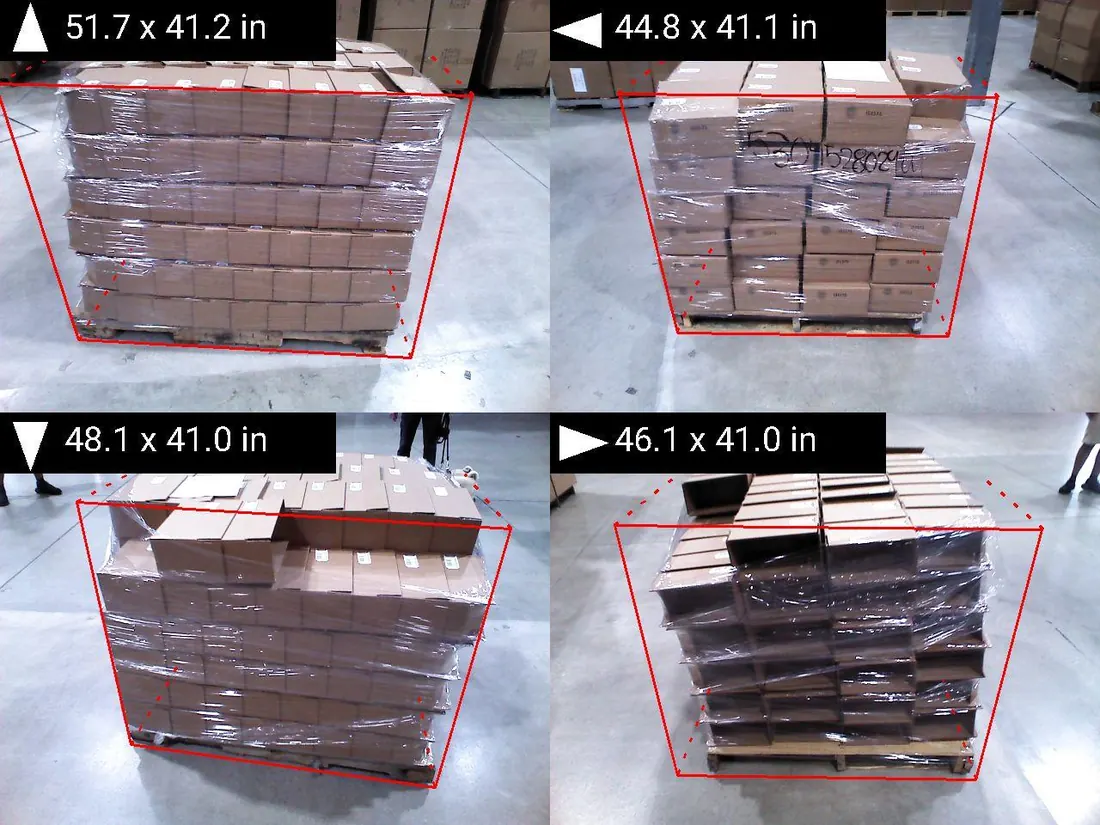
- Photograph each face as you measure, so the record shows what left the dock.
What to record on the bill of lading
Your carrier sets which fields its BOL requires. For density-based freight, keep these for every handling unit, on the BOL or linked to it:
- Dimensions
- Length × width × height in inches, at the extreme points
- Weight
- Per handling unit and for the shipment
- Count and type
- Number of handling units: pallets, skids, crates
- NMFC item and class
- The item number, sub, and the class from the density
- Photos
- Two to four faces of each pallet
- Timestamp
- When it was measured, and by whom or with which device
- Reference
- BOL, PRO or order number, so the record can be found later
Common mistakes
- Leaving out overhang, or measuring the load without the pallet.
- Using product or catalog dimensions instead of the built pallet.
- One set of dimensions for a shipment of several different pallets.
- Estimated or typical weights instead of a scale reading.
- Keeping a product's old class out of habit after the density rules took effect.
- Typing errors when dimensions are read off a tape and keyed in later.
- No photo when a carrier inspects or reweighs the shipment.
How teams capture this data
Three common ways to get dimensions and weight for each pallet at the dock:
| Method | How it works | Records for the BOL | Trade-offs |
|---|---|---|---|
| Tape measure and floor scale | Measure by hand, read the scale, type both in | Whatever is typed; photos only if taken separately | Low cost; slow, and overhang and typing errors are common |
| Overhead fixed pallet dimensioner | Pallets are brought under a mounted sensor, often on a scale | Dimensions and weight; photos depending on the system | Fast at one fixed lane; installation and capital cost; pallets must come to it |
| Handheld dimensioner | For example QBOID's M2 with the Pallets app: scan the BOL or PRO, photograph 2–4 sides | Dimensions, weight from a paired Bluetooth scale, photos of each face, ID, timestamp | Any dock door, no installation; about 3 ft up to 7 ft wide or tall, 1 in accuracy; not in direct sunlight |
The Pallets app records dimensions, weight and photos for each pallet; density follows from them, and your TMS, ERP or rating tool applies the class. It also has keys to record non-standard packaging and accessorials on the same record.
Prepare now: a checklist
- Find what ships LTL.List your most frequent pallet builds and SKUs, and check which have no measured dimensions or weight, or old ones.
- Find where the class moves.Work out density for your main shipments and compare it with the class you've been using. Start with the lanes and customers where it changes.
- Measure every handling unit at the dock.Dimensions, weight and photos for each pallet, not one figure per shipment.
- Update your systems.Work out class from measured density in your TMS, ERP or WMS, instead of a fixed class per product.
- Train the people involved.Dock, shipping and customer service staff: what to measure, what to record, and how to answer a reclass.
- Keep the evidence.Store dimensions, weight, photos and the timestamp with the BOL, so a reclass or reweigh can be checked.
- Follow NMFTA.Watch for new dockets on nmfta.org and review your class logic when they take effect.
FAQ
What is density-based freight classification?
Freight class set by density: the weight of a handling unit in pounds divided by its volume in cubic feet. Since NMFTA Docket 2025-1 took effect on 19 July 2025, most NMFC items use a 13-step density scale, from class 400 for the lightest freight to class 50 for the densest.
How do I calculate freight density?
Multiply length × width × height in inches and divide by 1,728 to get cubic feet. Then divide the weight in pounds by the cubic feet. A 48 × 40 × 52 in pallet at 650 lb is 57.8 ft³ and 11.2 lb/ft³, which is class 92.5.
Do the pallet and packaging count?
Yes. Measure and weigh the handling unit as you tender it: the pallet or skid, the freight and its packaging, at their extreme points, including overhang.
Does every item now use the density scale?
Most do. Some items keep a class of their own, so check your item's entry in the NMFC, or ask your carrier.
Can the M2 work out the freight class?
The Pallets app records dimensions, weight from a paired scale and photos of each face for every pallet; density follows from them. Your TMS, ERP or rating tool applies the class. See pallet dimensioning.
Where can I check the official rules?
NMFTA publishes the NMFC and its dockets at nmfta.org ↗. Dockets change the classification several times a year, so check the current one before relying on any table, including the one on this page.
Sources
- National Motor Freight Traffic Association (NMFTA), the National Motor Freight Classification and its dockets: nmfta.org ↗
- NMFTA Docket 2025-1, density-based classification, effective 19 July 2025: link to the docket page on nmfta.org. To confirm
- Secondary summaries of Docket 2025-1: Old Dominion Freight Line ↗, St. Onge ↗
- Worked example and boundary figures: our own arithmetic from the scale above.
- Pallets app range, accuracy and outputs: pallet dimensioning.

Author: to be named To confirmReviewed by Francesco Peruch, CTO, QBOID To confirm. Last reviewed 10 Oct 2026, against NMFTA Docket 2025-1. Reviewed again with each new docket.